
3rd March 2026
Essential (European) Kit Remote Workers Need in 2026
Remote working isn’t a new thing, but it has grown since the pandemic. Many businesses have embraced remote or hybrid working. This offers more...
Read More >
In 2017 Gavurin, our data company in the North East of England decided that, with promising growth, there was an opportunity to purchase a building of its very own. Various options were available: one based on the Gateshead side of the swing bridge, one an old library on Scotswood Road. Yet, it was a former sports court in Newcastle city centre that really captured the imagination. The old building, which had stood empty for many years, was perfect. 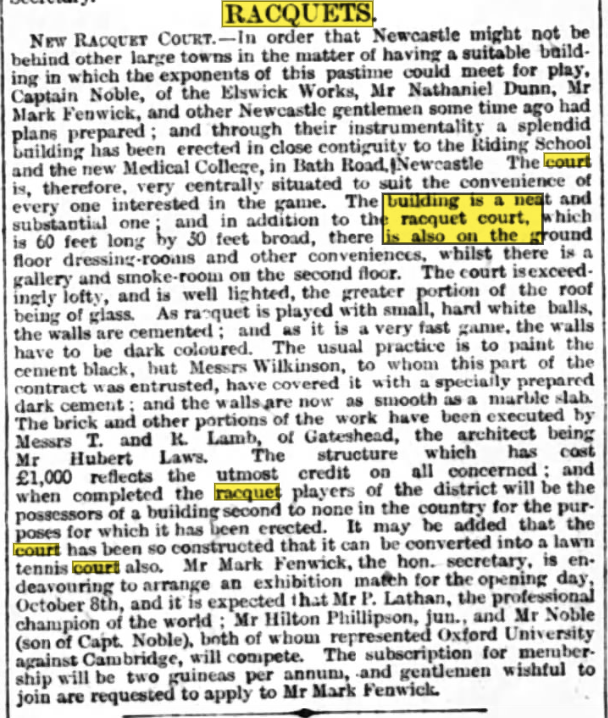
Newcastle’s racquets court was originally built in 1888 “in order that Newcastle might not be behind other large towns”, the building was a haven for racquet enthusiasts, requiring a mere two guineas for membership (this is around £210 today – according to the Bank of England’s inflation calculator).
How to play Racquets
Racquets (rackets) was played in a 30-by-60 foot enclosed court, with a ceiling at least 30 feet high. The walls and floor of the court are made of smooth stone and generally dark in colour to contrast with the white ball. Read more
The subsequent chapters of the buildings history remain elusive, marked only by a sign stating ‘Northumberland Table Tennis Club’.
When we acquired the building from Newcastle City Council, it stood as little more than a cavernous shell. There was a small viewing platform, the beautiful spiral staircase, a striking glass ceiling, and basic amenities constituted it’s humble inventory. Undeterred our vision became clear – to create a beautiful workspace which combines state-of-the-art technology, housed in a truly unique and historical venue.
Preserving the buildings history proved both challenging and rewarding. The original brickwork, the staircase, the weathered walls bearing the scars of countless racquetball impacts – all bore witness to a bygone era.
The ceiling had to be modernised, reinforced and the old panes of glass replaced. We even added in self-opening panels. The staircase, while stunning, didn’t comply with modern building regulations, so was carefully repaired and relocated within the building and now used as a stunning ornamental feature adorned with a variety of plants (and decorated at Christmas).
We added a small extension to house the entrance area, main staircase, essential amenities, and a cosy private office complimented by a rooftop terrace. The newly added first floor became home to a number of work and meeting spaces.
Throughout the process, our data company evolved and our vision for the building grew. We saw potential in the space and knew we could now share this with likeminded organisations. Thus, The Racquets Court, the coworking space, was born – a hub for innovation and collaboration.
In May 2019 it was finally time to open our doors as we held our launch event. Officially opened by Nick Forbes, then leader of Newcastle City Council, and attended by local businesses, NE1, Newcastle & Northumbria Universities. We also welcomed the contractors who had so efficiently delivered the project –IDP (our architects), Elliott Associates (our quantity surveyors) and Tolent (our building contractors). Tolent very sadly is no longer around – a very significant loss to the North East business community.
“Newcastle was home to the first industrial revolution and we need to be a part of the next industrial revolution too. What you’re achieving here is, I hope, a part of a bigger narrative for the rebirth and regeneration of Newcastle as a major global city. The transformation if this building symbolizes the rebirth and regeneration of Newcastle.” – Nick Forbes
With such a promising start, no one could have foreseen what came next. The world was changing and in the March of 2020 we, like everyone else, went into lockdown. Being a new, small, independent business, the pandemic hit us hard, but we made it through. The world on the other side had changed – a world now driven by the flexibility of remote work, where coworking spaces flourished in the wake of traditional office lets.
With more and more businesses prioritising the wellbeing of their staff and the use of hybrid and flexible working as a recruitment and retention tool, the rise of coworking space has seen our space flourish.


""
-
3rd March 2026
Remote working isn’t a new thing, but it has grown since the pandemic. Many businesses have embraced remote or hybrid working. This offers more...
Read More >2nd March 2026
We have been Dog Friendly on a Friday for a while now. Why? Well, we like dogs (that’s our director’s dog, Buddy, to the...
Read More >The co-working hybrid is a mix of the modern and the traditional. We’ve picked the best aspects of each to create our product
Traditionally favoured by independent workers and start-ups, co-working has steadily grown over the years and is now considered a ‘must’ by many large companies and remote workers. It’s even a great way to create a new base for your company in various locations with fewer overheads while allowing you to recruit from a wider pool of candidates.
The first official co-working space opened around 2005, however, this office movement is thought to have stemmed from 90s Hackerspaces. These spaces were originally created as a solution for lone workers, allowing them somewhere outside of their home to work and socialize. Historically, co-working spaces were different from serviced offices as they were created by and for the ‘creatives’ rather than the ‘suits’. In recent years, these two types of the workplace have begun to blend making way for a new collection of spaces with different focuses.

Take us for example, while we have taken some elements of a serviced office, we have also taken inspiration from the co-working movement. This is partly to do with the physical aspects of the building. As a former sports court, there was a huge open space and high ceilings allowing us to add an upper floor. Rather than creating traditional, boxed in offices, we wanted to look to the new way of working and the ‘co-working values’ of collaboration, openness, community, accessibility, and sustainability.
Open-plan spaces are social. They are designed to encourage communication and promote a sense of teamwork due to the diversity of its members. It becomes a place where like-minded businesses can inspire one another, network and potentially find collaborative work partners. Finding yourself sharing a space with an array of people from different backgrounds, with different interests, different businesses and different goals give you unique opportunities that would have otherwise pass you by in a more typical office building.
“[Co-working] is a place and a style of working that combines independence and co-dependence. One that allows you to be a soloist, but still plays in the orchestra. To be social when you need to and to hold you accountable for delivering the things you say as important” (Dunstan, M (2015) The Co-working Revolution: Four Secrets to Successfully Working for Yourself)
While bean bags and pool tables may be suitable for the more quirky co-working space, we have followed a more traditional aesthetic but with our own twist. We chose a calming blue colour scheme as this is said to improve efficiency and performance, and rather than removing the original glass ceiling, we restored it and added several other large windows around the space. Natural daylight has been proven to enhance productivity, health and mood. We knew also that for the work our current and future members do, our priority had to be to get the essentials right (such as connectivity, comfort, location and a focussed environment to name a few) and offer a high quality, well thought out product.
Book Now
""
-
3rd March 2026
Remote working isn’t a new thing, but it has grown since the pandemic. Many businesses have embraced remote or hybrid working. This offers more...
Read More >2nd March 2026
We have been Dog Friendly on a Friday for a while now. Why? Well, we like dogs (that’s our director’s dog, Buddy, to the...
Read More >