3rd March 2026
Essential (European) Kit Remote Workers Need in 2026
Remote working isn’t a new thing, but it has grown since the pandemic. Many businesses have embraced remote or hybrid working. This offers more...
Read More >
Virtual office. You’ve probably heard the phrase bandied around or seen it written down when you’ve been looking into setting up your business. So what is a virtual office?
Basically a virtual office falls under the flexible workspace umbrella. It is a way for a business to have a presence in an area where they don’t want or can’t be physically located. A virtual office plan, package or subscription gives businesses an address and sometimes a phone number and other benefits, usually at a business centre, co-working space or shared office, without paying to actually use the physical space.
Virtual offices have been an option for businesses for many years now, so they aren’t a new phenomenon. Since the rise in flexible working they have become more and more popular. With video conferencing and a work-from-anywhere mindset, a virtual office fits in nicely to help establish your business without facing the massive (and often underestimated) overheads of renting physical office space.
Start-ups use virtual offices as a way to be seen to be in a city centre or cluster related to their industry.
Companies who don’t require a physical office space but don’t want to list a home address as their business address.
A Virtual Office gives you a single location to use as your base without needing to commit to being there.
Rather than setting up a physical office, a VO can help you find out if there is a demand in an area for your business or give you a presence in a city before you setup a physical office
As with everything, there are pros and cons of using a virtual office which may help you decide if this really is the right option for you.
So, do you need a virtual office? If you’re a start-up, a small business or need a presence in a certain city, a virtual office is probably the most affordable way to do so with very low risk. They are easy to setup, easy to manage, easy to grow from and easy to move on if/when you outgrow it.
Research the difference packages and plans in the city you need before you commit to ensure you can access all the elements that will help make your business thrive.
Book Now

""
-
3rd March 2026
Remote working isn’t a new thing, but it has grown since the pandemic. Many businesses have embraced remote or hybrid working. This offers more...
Read More >2nd March 2026
We have been Dog Friendly on a Friday for a while now. Why? Well, we like dogs (that’s our director’s dog, Buddy, to the...
Read More >Guy Fawkes Night. Firework Night. Bonfire Night. Whatever you call it, it’s here.
On 5th November each year, we gather at various firework displays on the anniversary of the infamous Gunpower Plot (1605). After the failed attempt on the King and Parliament, people up and down London began lighting bonfires in celebration. And thus, Bonfire Night was born.
Nowadays, celebrations often include elaborate firework displays, laser displays, even drone displays, alongside fairground rides, food stalls, flashy toys and that all important community spirit.
Here are some of the local firework displays happening in Newcastle and the surrounding areas this year.
Blydon RFC Bonfire & Firework Extravaganza – On 5th November from 5pm and fireworks from 7.15pm. Hosting their 16th annual bonfire and firework night, Blaydon have music, bars open, bonfire, fairground rides plus catering vans all to showcase their choreographed firework display set to music.
Let us know which bonfire night events you enjoy so we can add them onto our list for next year!

Book Now
""
-
3rd March 2026
Remote working isn’t a new thing, but it has grown since the pandemic. Many businesses have embraced remote or hybrid working. This offers more...
Read More >2nd March 2026
We have been Dog Friendly on a Friday for a while now. Why? Well, we like dogs (that’s our director’s dog, Buddy, to the...
Read More >Stress. It affects us so much more than we realise. From our personal relationships to our jobs, our bodies and our minds. In this blog, we are going to look at work-based stress, how to identify it, how to voice it and some resources to help manage it.
Stress is the body’s reaction to feeling threatened or under pressure. While it can help us stay focused and achieve things at work and in our personal lives, too much stress can have very negative side-effects and lead to burnouts and longer-term mental health conditions such as depression and anxiety.
Stress statistics from Champion Health:
A common piece of advice when stressed in to plan ahead, but often the things that lead to stress are the things we have little or no control over. From being pulled in too many directions at work to uncertainties around rising costs both at work and at home to trying to juggle work and family life, there are just so many factors that it feels impossible to be able to plan enough because there is always something else waiting around the corner.
Stress can present differently in different people so it’s difficult to say for certain how it will present, but we do know about some common warning signs that the stress is becoming too much.
People tend to withdraw to protect themselves from other pressures or situations which could lead to extra pressure. Taking time for yourself is very important to helping battle the signs of stress, but you need to strike the right balance to avoid growing feelings of isolation and anxiety.
Because stress activated your fight or flight response, you body may struggle to produce melatonin (the sleep hormone). It also becomes a vicious cycle because when you can’t sleep you begin to worry about not sleeping which increases stress.
In times of stress we often turn to things that help us relax such as alcohol. While some have suggested that alcohol can hide some of the symptoms of stress (i.e., feeling more relaxed, boosting your mood, and providing a distraction) over time we can become intolerant to the ‘de-stressing effects’.
Losing interest in things that once brought you joy can be a sign of stress as well as a sign of other conditions. Often this is a result of lack of sleep and a general feeling of being overwhelmed.
Stress is often caused by short-term issues or pressures, but excessive stress can lead to longer term issues such as anxiety or depression.
Trouble managing your emotions or becoming overwhelmed often are a sign of stress.
These can include panic attacks, muscle aches, headaches, stomach/digestive problems to name a few. Often the more stress you are feeling the worse the physical symptoms appear.
From the NHS website, its recommended that you:
In the workplace, it’s important to try and understand what is causing you stress specifically, is it a work-based stress or an external factor? What control do you have over this?
Speak to your line manager or mental health first aider if you have one. Work with them to devise a plan to help you cope with your stress and regular check-ins. If you don’t feel this is possible, turn to a co-worker or close friend who you feel comfortable speaking with.
Book Now
""
-
3rd March 2026
Remote working isn’t a new thing, but it has grown since the pandemic. Many businesses have embraced remote or hybrid working. This offers more...
Read More >2nd March 2026
We have been Dog Friendly on a Friday for a while now. Why? Well, we like dogs (that’s our director’s dog, Buddy, to the...
Read More >
Located in the Grainger Market, SnackWallah serves authentic vegan Indian street food and proudly state that “All our food is vegan, healthy and delicious”. Their menu includes items such as: Bhaji Wrap, Curry of the Day (with daal, rice and naan) and Mumbai Sandwich.
Their opening hours are:
Monday-Friday 11am-4pm
Saturday 11am-5pm
Based on Collingwood Street, this chicken joint serves chicken (surprise surprise!) cooked rotisserie style over open fire-pits. Takeaway and eat in options available, the menu includes: Dirty Box (Takeaway only), Whole Chicken with 3 sides and their famous COOP wings.
Their opening hours are:
Monday, Friday & Saturday 12pm-10pm
Tuesday-Thursday 12pm-9.30pm
Sunday 12pm-8pm.

A proper hidden gem and less than a minutes’ walk from our own front door is Kato Pan Asian Cuisine. With dine in and takeaway options available it has branches on Saville Row in Newcastle city centre and Sunniside in Gateshead. Their menu includes items such as: Breaded Prawn Katsu Curry, Grilled Spicy Eel and Chicken Dumplings.
Their opening hours are:
Monday-Friday 11am – 7pm
Saturday 11am – 6pm
Bringing “authentic Hong Kong street food to the toon!” Pop Up Wok is another Saville Row eatery that serves “small portions of hot food, which full you up just enough”. Menu includes items such as: Pan fried crispy chicken dumplings, salt and pepper tofu and curry fish balls.
Their opening hours are:
Monday & Thursday Closed
Tuesday, Wednesday, Friday & Saturday 12pm – 6.30pm
Saturday 12pm – 4pm

If you’re looking for delicious real American cheeseburgers in the toon then look no further. Meat Stack has been bringing amazing burgers to Newcastle since 2016. Now in the Groat Market, their menu includes items such as: West Coast Classic, New Mexico and Yellowstone burgers along with a range of sides to go with.
Their opening hours are:
Sunday – Thursday 9am-9pm
Friday & Saturday 9am-10pm
A bit further afield, but you can order online and via Deliveroo. They create clean, healthy, nutritious and delicious food and drinks. They have sites in Gosforth, Chilli Road, Grey Street and York. Their menu includes items such as: Harissa & Chickpea VEGAN ‘meat’balls, Gochujang Tempeh Wraps and Protein Pancake Stack.
Opening hours vary from site to site.

Located inside Newcastle’s icon Fenwick store is Café 21. Described as effortlessly stylish and all day menu full of “fresh, light and flavoursome” dishes including a range of hot sandwiches, salads and Cacklebean Barn Egg dishes.
Their opening hours are:
Monday, Tuesday, Wednesday & Friday 11.45am-6pm
Thursday 11.45am-7pm
Sunday 11.45am-5pm
Just up the road from MeatStack is Twenty Twenty, a relatively new venue specialising in twenty inch pizza and twenty cocktails on the menu. This place is ideal for fun team lunches or you can even grab a single slice of their Neapolitan pizza. The lunch time meal deal includes: Giant pizza slice, butter salted or chocolate topped popcorn and a selected soft drink or any hot drink.
Their opening hours are:
Sunday, Wednesday & Thursday noon-1am
Friday & Saturday noon-2am

Newcastle’s first dedicated Mac ‘N’ Cheese dedicated restaurant is based in the Grainger Market and appears at Newcastle’s famous Quayside Market every Sunday. Their menu includes items such as: Chorizo Mac ‘N’ Cheese, Mac Burger and Sticky Rib Mac ‘N’ Cheese.
Their opening hours are:
Monday-Saturday 9am-5pm
Described as a food-lover’s heaven and located (as the name suggests) inside Fenwick on Northumberland street. With a Delicatessen Counter, fish and meat counters, Artisan Bakery, groceries and chocolate and confectionery departments, you can stock up on goodies to bring back to our fully equipped kitchen.
Their opening hours are:
Monday, Tuesday, Wednesday, Friday and Saturday 9am-7pm
Thursday 9am-8pm
Sunday 11am-5pm

Ridley Places’ famous Frankie and Tonys Sandwich Bar is a great spot to visit if you want a really good sandwich. With everything from classic sandwiches, to salad boxes, to jacket potatoes, this place offers quality food to go.
‘Nuff said. We’re based in Newcastle city centre so we are surrounded by Greggs and we love it.

""
-
3rd March 2026
Remote working isn’t a new thing, but it has grown since the pandemic. Many businesses have embraced remote or hybrid working. This offers more...
Read More >2nd March 2026
We have been Dog Friendly on a Friday for a while now. Why? Well, we like dogs (that’s our director’s dog, Buddy, to the...
Read More >Since March 2020 many employees were forced to work from home and discovered the simple joys in being there more. Time with the pets, time with the kids, less time and money spent on commuting, a few more hours of precious, precious sleep each week. Bliss. But we knew it couldn’t continue indefinitely. Not all home offices are alike. I heard rumours of people having to use ironing boards as desks, whereas other people had dedicated studies.
As time has gone on, fewer and fewer people have expressed a desire to go back to the ‘old normal’ which is putting pressure on businesses to think outside the box in order to retain talent and build their workforces.
Here, we will discuss a few ways in which companies can move away from the traditional way of thinking and create a more people-focussed workplace.

It sounds so simple! Some people thrive in the office environment, away from the domestic distractions. Some people suffer from lengthy, complicated commutes, leaving them tired and irritated before the first meeting has even begun. Perhaps some of your team are worried about dealing with the additional bills from having people in the house all the time, or perhaps some of your team are worried about passing viruses to vulnerable relative. Whatever their reasons, you need to understand where they are coming from. Find out what matters most to them and if/how you can facilitate this.
This is showing your team that they matter as an individuals. While you may not be able to completely deliver what each individual person wants, the fact that you’ve taken the time to speak with them and understand them will show that they are valuable and appreciated.
So if you’re moving towards a hybrid way of working with either some of the team working remotely or working remotely on set days, do you really need all that office space?
In the past, you would typically ensure you had space for at least the number of people you currently employed. But do you really need all that space? Some of the new ideas organisations are coming from include:
One of the other considerations is how your office actually works for your team. At home, they may have the choice to walk away from their desk and unwind on their lunch break, so making sure they have adequate break out spaces in the office is so important.
It’s all well and good telling your team that they can work remotely, but what if they don’t have the tools?
Communication software such as Microsoft Teams, Zoom and Skype for Business are vital to ensuring your team and a clear communication channel to their co-workers and leaders. If they have questions or need to virtually attend a meeting while working remotely, ensure they are familiar with how to do this. Set a protocol for how meetings should take place and how questions are raised.
And as a manger, are you able to review or assist when required? How are you sharing files and documents when not in the same office?
Other than software, you also need to consider the kit your team has. Are the laptops suitable to be taking in and out of the office every day? Are they powerful enough? Can the team answer calls from customers without giving out their personal mobile numbers?

Understanding who your team are will help you create a more people-focussed workspace. Even when working apart, regular check ins with individuals and ensuring there is an open communication channel will help your team feel connected. It also helps if they know that, even if they have decided to work from home, they can change their mind and you will try to help accommodate that, whether it is reviewing the office usage again or looking at external co-working spaces as a temporary solution.
Organised fun isn’t everyone’s cup of tea, but even trying to arrange some team games online or the odd quiz can help prevent isolation between remote team members. And of course, arrange some face-to-face socialising for those who feel up to it.
Book Now
""
-
3rd March 2026
Remote working isn’t a new thing, but it has grown since the pandemic. Many businesses have embraced remote or hybrid working. This offers more...
Read More >2nd March 2026
We have been Dog Friendly on a Friday for a while now. Why? Well, we like dogs (that’s our director’s dog, Buddy, to the...
Read More >By now most of us are familiar with hot desking, but what about desk hoteling?
Hot desking simply heading into the office (or co-working space, shared workspace facility etc) and using an available desk. While it does have many benefits, it also received its fair share of criticism.
Hot desking can be uncertain. You don’t know where you’ll be sat or who you’ll be sat next to. What if the office is full? This can be especially frustrating if you’re heading in 5 days a week as you have to take all your stuff in with you every day and always changing desks. Many offices use hot desking to maximise space efficiency and encourage team members to interact with different people.
Hot desking is suited towards people who use shared office facilities a few days per week/month. For example, if your team only need to use a couple of desks twice a week, a co-working space can offer you this without making you pay for the days that you don’t use. This is much better value than hiring a whole office suite that is rarely at 100% capacity.
But there is still an uncertainty about where you will be sitting, and will you be sat with your team?
Desk Hoteling is very similar to hot desking, but rather than it being first-come-first-serve, you can pre-book your desks to ensure you are sat where you need to be sat.
Often using an app or booking system, you can reserve specific desks when you need them with confidence.
This method of office management is wonderfully geared towards co-working spaces as it means you know the desk will be sanitised and prepared ready for your arrival, you won’t be wasting time trying to find desks near your colleagues, and you still only paying for the space you use.

As part of our research into making The Racquets Court as safe as possible during these unusual times, we are excited to announce that we are launching a new desk hoteling model which will enable companies and individuals to specifically reserve desks as and when they need them.
Simple head over to our booking page, sign up and select your desks and take it from there or get in touch with a member of our team
Book Now
""
-
3rd March 2026
Remote working isn’t a new thing, but it has grown since the pandemic. Many businesses have embraced remote or hybrid working. This offers more...
Read More >2nd March 2026
We have been Dog Friendly on a Friday for a while now. Why? Well, we like dogs (that’s our director’s dog, Buddy, to the...
Read More >We have a great bakery in our part of town. We have a Greggs also – equally great, just different. In the former, I can buy a tremendous fruit loaf and their croissants are great too. But, for those who don’t live close to me, their choice is confined to Greggs. If I were to live in Brighton, it would be very different. We need more businesses in Newcastle to deliver jobs, GDP – and many more cakes.
Why can I taste the smell of bread, floating on the air in Brighton? It’s because there are more bakeries pumping their wares through the Sussex suburbs.
Put crudely, there are probably close to twice as many bakeries in Brighton as Newcastle. I’ve picked Brighton because the population is roughly the same size as that of Newcastle, even though it’s a seaside town and the business mix will be very different. If I abandoned population size as a constraint and stick with suburban places, then comparison with other South East locations suggests greater difference. For every one bakery in Newcastle, there will be 2.5 in Sevenoaks, Winchester and High Wycombe.
The chart shows how many businesses there are in Newcastle (per 10,000 people) by comparison with other cities. The differences are considerable. 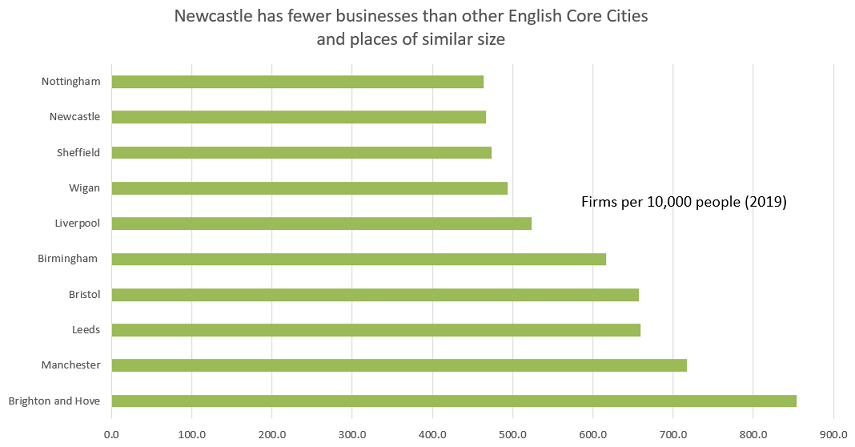
There are 2 reasons why the number of businesses in a place is important.
It is a crude concept, but the reason that I cannot secure excellent patisserie across Newcastle is that there are too few bakeries. Therefore, there is little incentive to create scrumptious cakes. Or let me bring this closer to my own experience. (In spite of my example, I’m not a frequent consumer of cakes).
When we were developing The Racquets Court, we tried hard to place small contracts locally. These captured things like furniture, phones, internal switching gear and so on.
We failed.
There were usually three reasons or this. Firstly prices were too high and/or secondly, response times were too slow. Or, thirdly, our demands for particular style and quality were too onerous.
Contracts for switching gear and phones went to Leeds based businesses and furniture contracts went to London based businesses. Competition, particularly services competion, is not significant enough close to home, here in Newcastle.
The impact on innovation follows on from the impact on competition. In research for the then Scottish Development Agency, we found that firms in the South East took up innovation faster than firms in Scotland. We attributed this to the impact of firm density. It will always be the case that fewer people and businesses will mean less innovation, but this was something in addition. There is less incentive to take up new ways of doing things.
Business density has a partner in the business birth rate / business death rate.
Let us assume two hypothetical locations – ‘dense’ and ‘sparse’. Dense houses 200 businesses and Sparse houses 150. Both however have the same business birth rate of 10%. Next year, Dense will therefore house 220 businesses and Sparse will house 165.
What began as a business stock difference of 50, has grown to 55. The rich really do get richer, while the poor really do get poorer.
If low business density has an impact on competition and innovation, it follows that productivity will be lower also. We have to increase the number of businesses.
This is a ‘thought experiment’ that starts with 2019 data – but of course the principle applies if we were to start today.
Today, Newcastle has a business density of 432 businesses per 10,000 people. North Tyne (the area covered by the Mayor) has a business density of 449 per 10,000 people. The business birth rate across North Tyne varies between 11% and 15%. If birth rates stay the same until 2024, and we assume working age projections from ONS, then business density for North Tyne will increase to 502 businesses per 10,000 people.
This is shown in the Table. 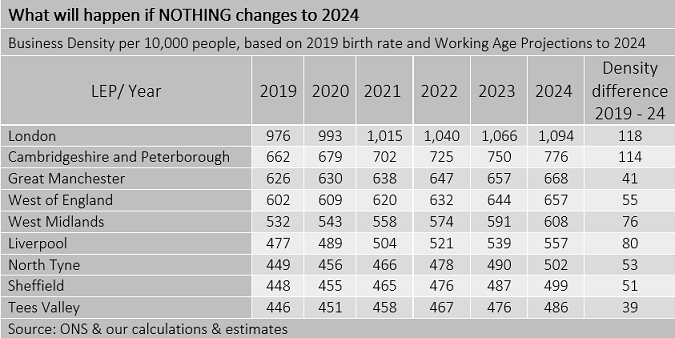
But of course, everywhere else is changing also. The table shows how a stable business birth rate interacts with ONS projections for the working age population to 2024. The table indicates the degree to which, over this 5/6 year period, places will catch up with one another. For example, in North Tyne, we’ll have 53 more businesses per 10,000 people; Greater Manchester will have 41 more. So we’ll have caught up a bit with Manchester. But we will have lost our advantage over Liverpool because they will have 80 more businesses per 10,000 people in 2024 than they had in 2019.
More than this, the table emphasises the significant differences between the South East and everywhere else that I indicated at the beginning.
I have argued in an earlier post that we should not be picking winners. There are two reasons for this. Firstly, it’s too hard. Secondly, attempting to pick winners consumes a lot of resource. Advisers, bankers, financiers, all combining skills to deliver some kind of alchemy.
What we should do instead is let the market pick our winners.
We’d be better off throwing (I use the word advisedly) a ‘start and run a business’ education pack to anyone who wants to start a business. It doesn’t matter whether it’s a haidresser or a search engine to rival Google. More people running businesses means more role models for others to do the same; more businesses means more competiton; more competition means innovation; more businesses will enhance productivity. More productivity means greater GDP. And so on. This is the virtuous circle we need.
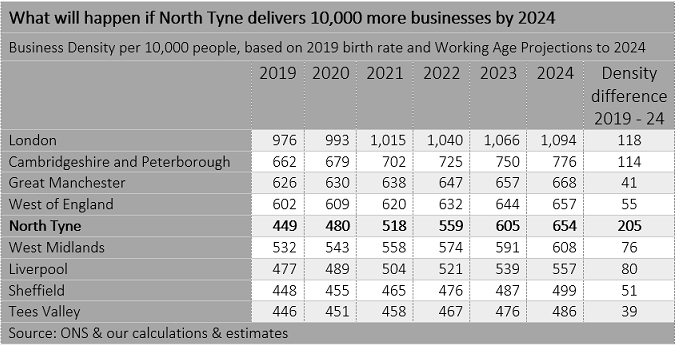 Let’s imagine that in North Tyne, we add 10,000 MORE businesses by 2024. Let’s also imagine that the other places in the UK identified in the table above, pursue the growth trajectory I show there – they do not change their current trajectory. IF we added 10,000 businesses in North Tyne, we’d shoot up the table to within a whisker of Greater Manchester.
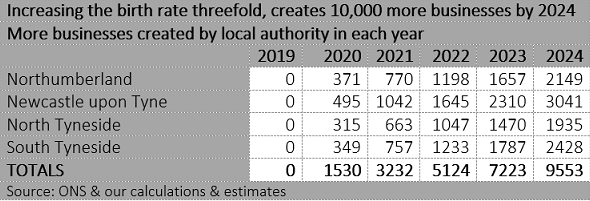
And let’s not forget how those 10,000 businesses to 2024 might be delivered. Firstly, it’s not 2,000 a year and secondly, the effort is distributed across four local authorities.
It is not 2,000 a year because it builds up – this is the virtuous circle effect. The final table below shows (a) how the effect accumulates over the years to 2024 and (b) how the heavy lifting would be distributed across local authorities.
Book Now
""
-
3rd March 2026
Remote working isn’t a new thing, but it has grown since the pandemic. Many businesses have embraced remote or hybrid working. This offers more...
Read More >2nd March 2026
We have been Dog Friendly on a Friday for a while now. Why? Well, we like dogs (that’s our director’s dog, Buddy, to the...
Read More >To grow a business, someone has firstly to start one and then run one. Admittedly the same person does not have both to start a business and run it, but for the moment let us assume that this is one person and that her name is Olivia1The most popular girl’s name in Britain 2019. . Olivia is interested in starting and growing a tech business.
There are two sources which inform our understanding of this. After that, we can consider the impact of these things on new business creation.
The 2 data sources that tell us about the environment for starting and running a business to grow it, are the World Bank Doing Business project and the Global Entrepreneurship Monitor project. The former offers a macro view, the latter a micro view.
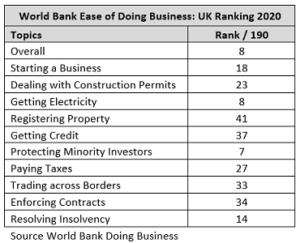 The WB Doing Business database captures 190 countries and ranks the ease of doing business across 10 variables. The table shows the summary results for the UK. The overall rank of 8 for the UK is very high. It is easy to ‘do business’ in the UK.
Note that the variables that contribute to this overall rank cover a lot of ground. They include for example that, in some countries, it is very difficult to access electricity. Also, in some countries, Olivia would find it hard because she’s a woman.
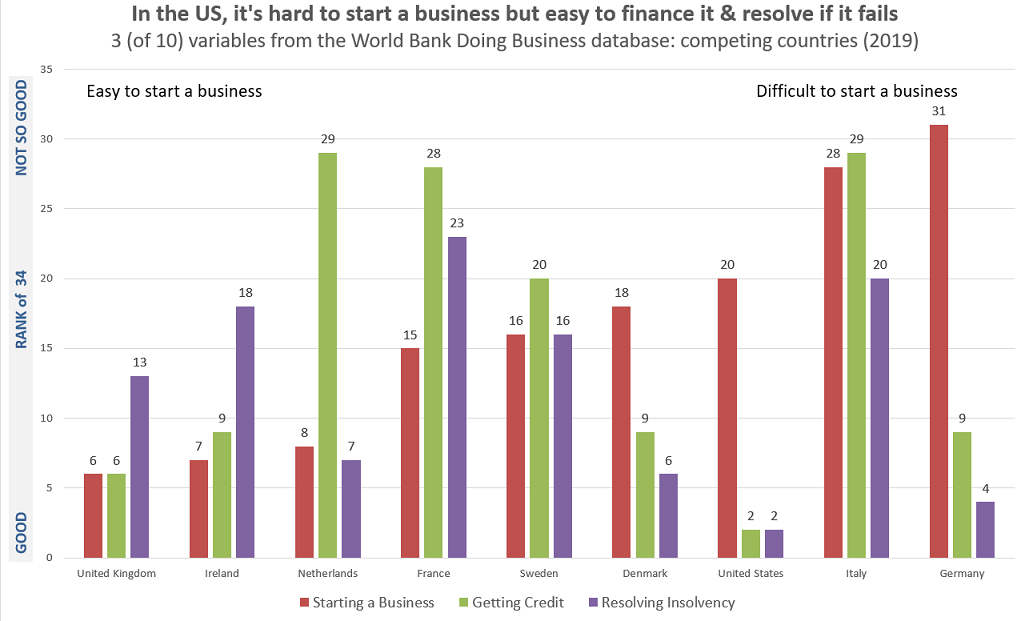 There are 3 World Bank variables that are particularly interesting for Olivia. They are: (a) starting a Business, (b) Getting Credit and (c) Resolving Insolvency.
For Olivia to grow her business, I suggest we need to look at an additional variable. I discuss that variable below.
This chart shows these 3 variables for a number of competitor countries. The ranking here is different. The ranking here is based only on the 34 members of OECD, not all 190 countries in the full World Bank Doing Business Database.
The chart shows just how different is the US from these comparison countries. My interpretation is summed up in the chart headline. In the USA (to which we should aspire in terms of their ability to grow businesses), it is hard to start a business, but much easier to grow it by accessing credit, and much easier to close it, should it run into trouble.
Resolving insolvency easily is important. Things go wrong and when they do, they should be sorted out quickly. Speedy resolution means that key players can move on, learn from mistakes, and start again. Many have pointed out that, in the UK, there is a degree of shame being associated with a failed business, while in the US it is viewed as a learning experience, a stepping stone, a rite of passage. The ease with which insolvency is resolved in the US is an aspect of this.
Subtly, the fear of insolvency affects entrprepreneurs’ attitude to risk. Growing a business involves taking risks. While I do not believe that people take reckless risk, it is obvious that reducing the ‘costs’ of insolvency is likely to enhance attitude to risk.
Global Entrepreneurship Monitor has been reporting annually since 1999. The 2019 report covers 50 countries. Each country has its own research team and produces its own report to a global template and standard.
GEM has a measure called ‘Total Early Stage Entrpreneurship Activity’ (TEA) which is the combination of two measures. Measure 1 is ‘nascent entrepreneurs’. 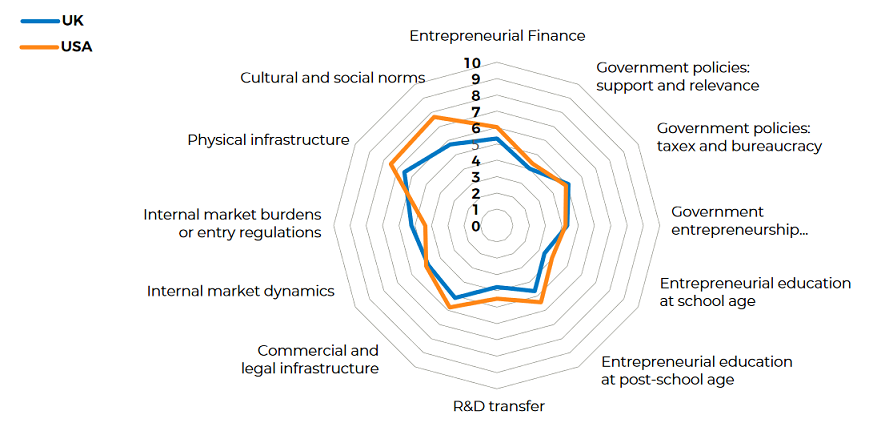
These are individuals who commit resources, such as time or money, to starting a business. To qualify as a nascent entrepreneur, the business must not have been paying wages for more than three months. Measure 2 is ‘new business owner-managers’. These are businesses which have been paying income, such as salaries or drawings, for more than three, but not more than forty-two, months. More detail on the methodology can be found in the UK 2019 report.
TEA for the UK in 2019 was 9.9% which is close to half the US rate of 17.4%. Although I’m not a fan of spider diagrams, this one shows the key differences between the US and UK which go towards explaining this difference. A score closer to 10 is better.
A look at the variables suggest that there is little local economies can do in the UK to address these differences. However, there is one exception to this – a variable that can be addresssed locally. And a second over which a degree of influence is possible. These are the two variables to do with ‘entrpreneurial education’. One of these looks at entrepreneurial education in schools. The other looks at entrepreneurial education post school.
Recently, I have sat in on virtual meetings and also seen commentary on social media which refer to the ‘digital jobs market’ in Newcastle. Apparently, a large proportion of all advertised jobs are tech related. Also, I have heard many references to initiatives designed to enhance the ‘careers’ of young people in technology.
But enhancing her ‘career prospects’ in IT, is not what Olivia wants. She doesn’t want a career in IT. Olivia wants to start and grow an IT business. Olivia wants to offer careers in IT.
For Olivia, this is a problem. She knows (because she’s read the GEM Report on Britain), that entrepreneurial education is important, but she struggles to find it in Newcastle. Olivia has looked at the syllabuses at Newcastle schools including Newcastle’s University Technical College and has come away disappointed.
Olivia was particularly disheartened by two comments on the UTC why we’re different page.
One comment told Olivia that she’d be wearing ‘business attire’ – which is not the image Olivia has of a tech entrepreneur. The other comment told Olivia that she would be occupied during ‘9-5 working hours’. And again, this does not match the picture Olivia has of life as a tech entrepreneur.
So, based on real data comparing us with other countries, it is possible to identify things we can do to help Newcastle build more businesses and bigger businesses. However, it is important also to recognise that nothing we do will deliver results fast. Some of the things that the US does, and to which I referred in another post (like SBIR), have been in place for many years. The UK, having implemented SBIR badly, abandoned it. Policies like enhancing entrepreneurial education need commitment and review continuously.
It is possible for Newcastle to get great. It can only do that based on understaning its position in the world. That understanding is ONLY possible by analysing data.
Policies are no good unless they are monitored. What is our starting point? How does Newcastle’s business demography stack up and what might be sensible targets for say 5 years? I discuss this here.
Book Now
""
-
3rd March 2026
Remote working isn’t a new thing, but it has grown since the pandemic. Many businesses have embraced remote or hybrid working. This offers more...
Read More >2nd March 2026
We have been Dog Friendly on a Friday for a while now. Why? Well, we like dogs (that’s our director’s dog, Buddy, to the...
Read More >Scaling up a small UK business is an issue. Many have referred to this. The chart shows it to be true. Growing a small business to be a medium one is difficult.
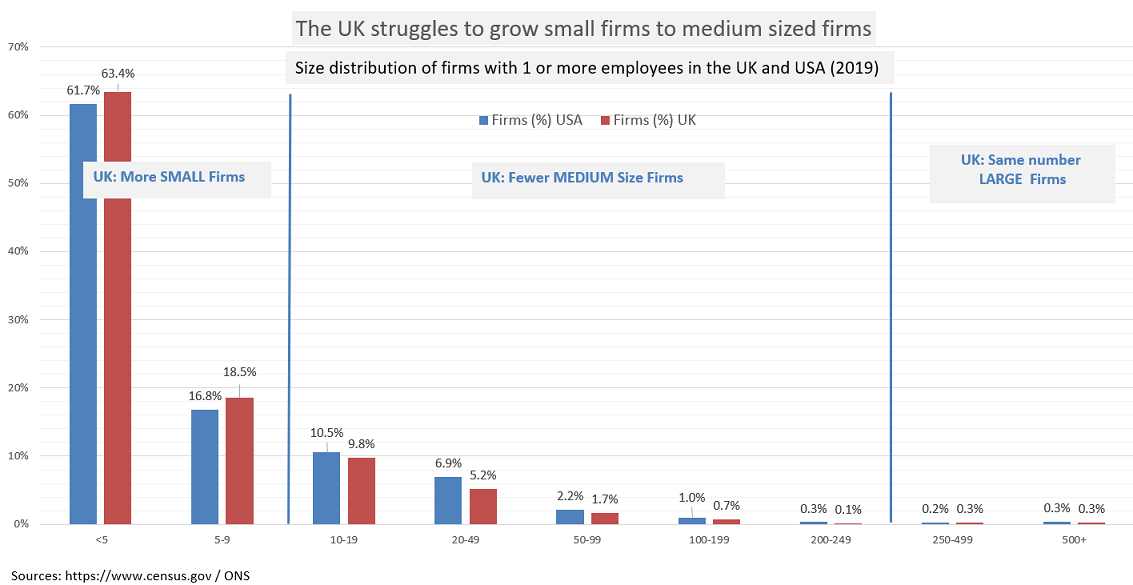
To address this, the UK has established the The Scale Up Institute. The mere establishment of this body lends weight to the problem and at the same time effectively downplays the importance of new business starts. In a piece in the Financial Times, John Mullins, an Associate Professor at London Business School is quoted saying:
“A common mistake is to focus on simply increasing the number of start-ups. Policy should instead be directed towards “scale-up” companies, many of which will already be trading but need to change their business model to find a more growth-oriented niche. Encouraging start-ups, given the churn that will inevitably occur among them, is the wrong place for government support. A wiser course would be to support growth in companies that are ready to scale up”
To which I would say:
Therefore, I don’t agree that this is an ‘either / or’ for Government policy. It’s both.
More than this, in arguing for us to direct support towards businesses that are ‘ready’ to scale up, we are lead to trying to pick winners. We first tried to pick winners for business support during Margaret Thatcher’s premiership. The UK returns to this theme regularly without any evidence that it is possible. It is true that the Scale Up Institute is saying that it is using AI to ‘pick winners’ so things may have changed. We will see.
All I would say is that in the USA, the most successful economy we seek to emulate, there are NO federal or State programmes that could be described as based on ‘picking winners’.
Therefore, start up and scale up are both important. How might we address deficincies in both?
The commentary around growing business is heavily focused on the failings of the firms themselves. Management is insufficiently skilled to grow the business. To remedy this, we have training and development programmes to ‘scale up’ small firms to large ones.
Of course it is possible that our entrepreneurs do lack the skills to grow businesses, although I am not sure how this could be established with certainty. However, the evidence does suggest that there is indeed an issue to do with ‘entrepreneurship education’ which I cover here.
There is an equally plausible explanation why the UK struggles to grow its small businesses by comparison with the US. This explanation is based on two things that distinguish the US and UK. Firstly, the US market is around 5.5 times that of the UK. This means not only that there are more people to sell to, but it also means that prices can be lower. The price advantage enjoyed in the US market can easily be extended to smaller, overseas markets creating a highly virtuous circle.
The business-to-business market is similarly distinguished.
The chart above does not capture firms with zero employees. In the UK, there are 4.6 million businesses with no employees. In the US, there are 24.8 million. Again 5.5 times as many. In total, (i.e. this number plus the numbers from the chart), there are 30.4 million businesses in the US; in the UK, there are 4.9 million.
This means that an SME developing business software has 30 million sales opportunities in the US and only 6 million in the UK. Pursuit of 0.1% of the business market in the US = 30,000 targets; in the UK = 6,000 targets. And so on.
This is a big deal. Speaking as someone who springs from a company that develops business software, I know that the US dominates almost every niche, with products that are cheaper than home grown examples. Having said that, I am intrigued that Australia and New Zealand seem to punch above their weight. Xero and Atlassian are examples.
Our membership of the EU should have addressed the market size issue. The EU market is even larger than that of the US. However, our 40 year membership of the EU has not obviously addressed the issue. This suggests the second of my speculative guesses about why the UK does not grow its small businesses. This is the British (losing) struggle with foreign languages. Not only does the US have 30 million business to business sales targets, those targets also all speak English. Selling to 0.1% of them in the US, delivers a financial platform to develop foreign language versions of whatever it is being sold. Yet another virtuous circle.
While I recognise that our membership of the EU single market may not have impacted the chart above, it is surely the case that exiting the single market will not have helped.
But for the moment, we have three possible explanations why the UK does not grow its small businesses: our entrepreneurs are not skilled enough, the UK market is not big enough and we expect our customers to speak English more than we should.
The first of these explanations, that our entrepreneurs are insufficiently skilled, is supported by the findings of the Global Entrpreneuship Monitor. They are particularly pertinent to Newcastle and the North East. This is discussed here.
Book Now
""
-
3rd March 2026
Remote working isn’t a new thing, but it has grown since the pandemic. Many businesses have embraced remote or hybrid working. This offers more...
Read More >2nd March 2026
We have been Dog Friendly on a Friday for a while now. Why? Well, we like dogs (that’s our director’s dog, Buddy, to the...
Read More >