3rd March 2026
Essential (European) Kit Remote Workers Need in 2026
Remote working isn’t a new thing, but it has grown since the pandemic. Many businesses have embraced remote or hybrid working. This offers more...
Read More >
When they are right, why are economists so easily ignored? Simon Wren Lewis, a macro-economist wrote a recent, good, blog on this. For those of us who have worked with regional economics, the problem is further complicated because the data is messy. But, ‘levelling up’ regional economies requires us to grapple with these difficulties, all the while remembering that we’ve been here before.
For example, not too long ago, most of us accepted that small firms create jobs and big firms lose them. That conclusion is now mediated by some who say that the quality of the created jobs is poor and low skilled. Or, that we do not need jobs in more firms, we need more jobs in fewer, high growth firms.

The latter is a very seductive argument for regional players. The PR that comes with association with a high growth business is attractive. And in a small regional economy (like that of Newcastle and its neighbours) it is easy for a very small number of growing business to assume significant status.
So do we need more firms? Or better firms?
In the North East, what are the features the regional economy that need ‘levelling up’ and what do we do to make it happen?
Along with others, I would argue that GDP is the key metric that would indicate that ‘levelling up’ has been succesful. If we achieve higher GDP, almost everything else follows. So what needs to happen to raise regional GDP?
In the period of the last Labour government, a lot of money slushed around to deliver regional growth. Agencies were created and research funded to answer what, at the time, appeared to be useful questions.
I think that a lot of that research was good, empirically robust and policy driven. Also, a significant number of good ideas were copied from the US.
However, the initiatives that flowed from the research were often badly implemented or non-existent. The project management was terrible.
Where ideas were copied from the US, there was little attempt to understand why they worked on the ground in America. What was it about the particular US environment that made them work?. 1Two initiatives which are examples of this are SBIR (the Small Business Innovation Research initiative) and BIDs (Business Improvement Districts). The former is long abandoned in the UK, but going strong still in the US; the latter is going both here and in the US, but rather more succesfully in the US. There is more detail about why these initiatives were poorly implemented in the UK here.
And at the end of this golden age of economic development initiatives, we’re still talking about the need to ‘level up’.
Unlike the ‘golden age’, the last decade has witnessed an almost complete absence of notable, centrally driven, regional economic research. Picking the golden nuggets from the golden age, I would argue for the following, ‘truths’ :
In this post and others which follow, I discuss these point with a focus on the North East with an attempt to use official data (ONS / NOMIS).
I am not reviewing the academic work on all of this. I hope I manage to inject a measure of ‘it’s obvious isn’t it’ without referencing the literature.
 I am not going to say much about this. The initial research was conducted by David Birch at MIT. In 1979 he published The Job Creation Process, in which he showed that most new jobs in the US are created by small companies. This study caught the attention of politicians at home and abroad. Birch’s work, although criticised, is considered groundbreaking because it opened the study of small businesses, which had been disregarded by economists before this.
The research to see if what Birch had found in the US, applied in the UK, was funded by the Department of Education and undertaken by Trends Business Research (confession: this is a company which I founded). More recently, but still more than 10 years ago, the Department of Business (BEIS) commissioned a team at Aston University to look again – and the core finding that small firms create jobs, holds true.
When I first got involved with these findings, like many, I was initially surprised by them. Surely, big firms must turn in big job creation alongside big revenue. But a few moments reflection tells us that the finding is accurate. The news we read is of big firms delivering real, significant job losses and the number of small firms an any economy far outweighs the number of big ones. Common sense affirms the core finding. And although I am not reviewing the literature, I will say (because I know it to be true) that Trends Business Research went to the most enormous trouble to confirm the data.
This is not to say that other points about the quality of the jobs or the regional disparities or the sector distribution are not accurate. It is merely to say that job creation comes from small firms.
With that thought, the bigger question is why does the UK struggle to grow firms? What is the size of the problem? I discuss this in this post.
Book Now
""
-
3rd March 2026
Remote working isn’t a new thing, but it has grown since the pandemic. Many businesses have embraced remote or hybrid working. This offers more...
Read More >2nd March 2026
We have been Dog Friendly on a Friday for a while now. Why? Well, we like dogs (that’s our director’s dog, Buddy, to the...
Read More >How must offices in a post Covid-19 world adapt to play their part in restoring vibrant life to our city centres? There are 5 lessons to learn.
In an earlier post, I spoke about what we’d like to see to encourage businesses and people back to Newcastle City Centre and its close neighbourhoods. Most of the things I spoke about are not within our gift. However, we recognise that businesses like ours – responsible for office space – have a part to play. How must The Racquets Court begin thinking big about smaller offices, to meet the changing demand for space.
In the past 12 months, we (and most of the planet) have learned how to work from home.
We know what we like about it and what we don’t. We know what we miss and what we do not. We’ve solved some problems and not others.
The genie is out of the bottle. It will not be put back.
We are not certain what all of these lessons are, but these are some that we are working with. We must:
The evidence suggests that, where home is comfortable, people enjoy working there. That phrase ‘where home is comfortable’ however is a big one.
There is an obvious connection between how well off someone is and the degree to which they find working at home comfortable. More than this, the better paid will find it easier to afford the additional costs of working at home. Although homeworkers save on travel (and on clothes that are worn below the waist), outside the South East, this may not compensate for the greater costs incurred for utilities.
There are other issues. ‘Before Covid-19’, home was big enough, now it is not. The desk chair used for brief periods before Covid-19 was OK; sitting on it now for hours at a time, it’s killing my back. Before Covid-19, the table was OK for brief periods of work; as a desk, the table is too small. And ‘my table’ has not before been used so extensively for work; my table is my metaphor for the difficulty of separating home from work. Where does one stop and the other start? Before Covid-19, this was relatively easy to distinguish; today it is much harder.
Connectivity? OK for my personal use; Zooming and Teamsing all day is entirely different. And my partner is on it too – it won’t cope.
Microsoft has largely found itself missing out on the plethora of slang associated with the harms associated with video conferencing. We have ‘Zoom Gloom’ and ‘Zoom Fatigue’. The slang does however mask real concerns about the psychological impact of the exccessive use of this technology.
So we should assume that employers who care about their people will wish to reduce the use of Zoom and Teams by bringing them back into an office – at least for part of the week.
We have to be comfy. We’re not ‘home’ but we can be a great alternative. You will not get a bad back sitting at your desk (because the chairs have won design awards in Germany and the USA). The desks are amply sized, screened and with nifty pull away tops to hide the wires. They are made in Yorkshire. The office will be quiet because the carpet is designed to insulate you from office noise.
The coffee won’t run out, because it’s locally sourced and delivered. When the building is full, you’ll be able to reach into the fruit bowl and grab an orange or an apple, sourced from Grainger Market. You’ll never have to wait for the kettle to boil or for the tap to run cold because boiling and chilled water is on tap. And your space will be clean – because we clean it every night. (And we employ our own cleaners – on excellent terms and conditions).
These luxury features have guided us from the beginning; we have always wanted to be thinking big about smaller offices.
You will probably not want space every day of the week. We will therefore offer you space when you need it. If you need desk space for only 0ne or two days a week – then we will make that possible. If you need one desk one week and two every other week – we’ll accomodate that too. If you need to meet others in the middle of the night – well, that OK because the building is 24/7.
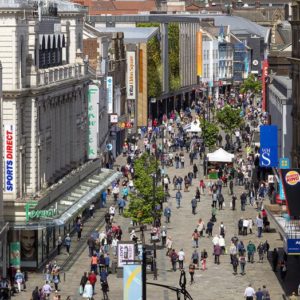 We recognise also that this way of working is unlikely to reduce the Zoom or Teams load. This is because not all of your people will be together at the same time. So we will make our meeting spaces more flexibly available. Before Covid-19, meeting room were bookable for a minimum of half day. We will reduce this to 2 hours for those outside The Racquets Court; for members, we will reduce this to one hour.
And of course, you do not have to worry about connectivity. The Racquets Court is one of the very few buildings connected to Stellium’s Metro Network. We have a Gigabit carrier and 200 Mb up AND down. Every desk has a wired connection and there are 3 wireless networks in the building. If you need extra security, then we can offer your own connectivity the Metro Network.
Currently, desks are socially distanced; we have reduced the capacity of our cafe area.
We have installed a facial recognition, no touch, temperature scanner. We anticipate that everyone entering The Racquets Court will wish to ‘scan in’.
There is a hand sanitisation station at the entrance to the building and all sinks are stocked with Arran Aromatics luxury hand wash and hand cream. Regular handwashing and sanitising is drying out our hands. It is very important therefore to moisturise them.
Additionally, The Racquets Court has a sophisticated air circulation system. It does not have air conditioning. The system continuously draws fresh, filtered air into the building and pushes out the air from inside. 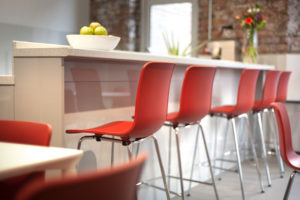 Therefore, you can feel confident that the air you breathe is as fresh as possible and filtered.
Our system is also more environmentally friendly than air conditioning, helping to protect our planet as well as our people.
The Racquets Court also has a self-opening glass roof for maximum fresh air. And of course, it has rain sensors so it closes automatically when the weather turns.
Many of us are avoiding public transport and cycling. Newcastle City Council is promoting this of course with more cycle lanes. The Racquets Court has secure bike storage. And there are luxury showers to freshen up (Arran Aromatics toiletries provided).
If you are running a business, and you’ve downsized your office needs, we assume that you will wish to devote resource towards making your people feel as though their home / office balance works in their favour. This is about your business thinking big about smaller offices.
If you can get it right, if your people feel that they can get the best of both worlds (comfort, ease, frustration-free, hygiene factors satisfied), then employee satisfaction will be high and productivity will increase.
And the cost to you is predictable; there will NO additional costs except for those you ask for such as a meeting room for an hour or two.
If you are an employee, then going to the office should be an appropriate alternative for everything that working from home might offer. And perhaps that should include the odd additional trinket that you might not get at home. This might capture some of the things mentioned above, but also easy access to John Lewis, Marks & Spencer and Fenwick, a drink after work in a City Centre pub, followed by a trip to the cinema or theatre.
This is what we mean by thinking big about smaller offices
In my last post on this subject, I talked about Newcastle’s ‘bit’ – those things over which we have no control which make our City attractive. This post has been about our ‘bit’
Our ‘bit’ is the offer of luxurious office space in the centre of our City which people will WANT to work in. The future appears to be that many of us will wish to combine working from home and at the office; we believe that The Racquets Court can be ‘the offfice’ that makes this combination work to the benefit of businesses and the people who work in them.
Book Now
""
-
3rd March 2026
Remote working isn’t a new thing, but it has grown since the pandemic. Many businesses have embraced remote or hybrid working. This offers more...
Read More >2nd March 2026
We have been Dog Friendly on a Friday for a while now. Why? Well, we like dogs (that’s our director’s dog, Buddy, to the...
Read More >Working from home has made many of us re-evaluate our office essentials.
At first I thought all I needed was a table, a chair and a spot to call my own, but it turns out I was wrong. There is much more to an office than the basic furniture, so I’ve made a list of my 10 top office essentials.
I cannot stress this enough – headphones are VITAL.
Sitting in the office with several people shouting at their screens is one of the most annoying things about the modern office. Even at home we’re often battling with general household noise and distractions. Investing in a good pair of headphones helps you moderate your volume, keep your conversations more private PLUS you get to listen to the music you like!

If working from home over the last few months has taught me anything, it is that my old kitchen stools are no match for a decent office chair.
Being able to adjust the height, the back and overall position of your chair can help improve your productivity. Have a look at ergonomic chairs, and general office furniture. It is more important than many of us realise.

According to Windows Central “Ergonomic keyboards focus on natural hand and wrist position for long typing sessions”.
I find my ergonomic keyboard helps me type faster and more accurately, and is just generally more comfortable!

Again, this is related to posture. If you’re short (like me) you find that your feet never do quite reach the floor properly. A little footrest is ideal for helping you maintain a good posture. But you don’t have to be short to benefit from a footrest. They are great for encouraging active sitting and reducing pressure on your legs.

If you have a work phone and a personal phone, invest in some back up phone chargers. There is nothing worse than digging around in your bag when your phone is on 5% and you’ve got important calls to make.

It is so important to keep yourself hydrated and having a nice water bottle on your desk is a great reminder to drink water!
Drinking water is also great for reducing stress, stopping headaches and improving general health which definitely makes it an office essential.

Now more than ever, it is important to take care of ourselves. While washing your hands is still the best method for keeping them clean, hand sanitiser is great for when you’re on the go, but also very handy for using on surfaces (desks, keyboards, phones etc)

It’s no lie that we LOVE office plants at The Racquets Court. They are amazing thing for many reasons.
Not only do they improve air quality, but they also improve attention span, lower stress, increase productivity and they look great!

I’ve mentioned this a few times, but posture is so important.
Being able to adjust your screen to the right height (top of the screen roughly at eye level) is essential to keeping your posture right and making your work-life easier.

Desk tidies come in all shapes, sizes and designs, but the main thing they all have in common is how useful they are for helping you stay organised. They often have small compartments for your notebook, pens, paperclips etc. Keeping a tidy desk makes it easier to keep things clean and stop you losing those important documents.

Think I’ve missed some office essentials out? Let me know in the comments below
Book Now
""
-
3rd March 2026
Remote working isn’t a new thing, but it has grown since the pandemic. Many businesses have embraced remote or hybrid working. This offers more...
Read More >2nd March 2026
We have been Dog Friendly on a Friday for a while now. Why? Well, we like dogs (that’s our director’s dog, Buddy, to the...
Read More >It turns out that 2020 hasn’t quite gone as planned for most of us, but now we need to focus on how to adapt in this new world.
When we built The Racquets Court, the idea was to create a close-knit community. A place to build strong relationships, new collaborations and explore new and exciting projects. At the beginning of 2020, our memberships was growing steadily, enquiries were increasing and we were having new conversations with different organisations nearly every day. Lockdown meant we had to press pause on many things and think of ways we could continue to function as a workspace, but, a workspace where people feel safe and comfortable to work from.

We attended several (virtual) seminars about getting back to the office, making the office safer and co-working communities in general, all of which gave us some good ideas to explore for The Racquets Court. We took time to conduct research into our ideas and sought feedback from members, visitors and followers and finally arrived at ideas to improve the safety within our space and promote good health.
Fortunately, The Racquets Court has a sophisticated air circulation system rather than air conditioning. Why is that important? The system continuously draws fresh, filtered air into the building and pushes out the air from inside. Therefore, you can feel confident that the air you breathe is as fresh as possible and filtered.
Our system is also more environmentally friendly than air conditioning, helping to protect our planet as well as our people.
And, on top of this, The Racquets Court has a self-opening glass roof for maximum fresh air. The clever thing is, it has rain sensors so it closes automatically when the weather turns.
We mention this regularly because it really is important – and getting more so with every day that passes. The Racquets Court is one of the few buildings in the North East connected to the Stellium Network. Our standard network speed is 200MB (up and down) via a gigabit carrier. This means your video conference calls and online collaboration platforms will perform better, enabling you to work for efficiently.
Our research indicated that the majority of respondents felt safer with a temperature scanner at the entrance to their workplace. Although body temperature is not a substitute for COVID-19 testing, it does indicate whether someone should be entering The Racquets Court and our scanner gives an audible response and is capable of facial recognition. This therefore helps us to protect our members.

We fully promote social distancing with The Racquets Court. The desks are spaced out throughout the building and we have reduced capacity in the smaller spaces such as meeting rooms and the main kitchen.
We have installed a hand sanitisation station at the entrance to the building and have ensured all sinks are stocked with Arran Aromatics luxury hand wash and hand cream. Regular handwashing and sanitising is drying out our hands (a small price to pay to prevent the spread of COVID-19), however as the colder months come, it is very important to look after hands – and moisturising will do that.
While many people have been enjoying working from home over the summer, as winter comes, the heating comes on and the bills go up. Our packages include utilities so your team can relax a bit when it comes to heating and electricity bills at home.
Avoiding public transport can be a pain, but something many of us are doing. We have secure bike storage along with showers (Arran Aromatics toiletries provided) to help you get into work safely.
You can read more in our Safe Working Guide.

If you would like to explore workplace options at The Racquets Court, get in touch with a member of our team today.
Book Now
""
-
3rd March 2026
Remote working isn’t a new thing, but it has grown since the pandemic. Many businesses have embraced remote or hybrid working. This offers more...
Read More >2nd March 2026
We have been Dog Friendly on a Friday for a while now. Why? Well, we like dogs (that’s our director’s dog, Buddy, to the...
Read More >You may have noticed that in 2020, nothing is quite how it was and that includes office space. With more people than ever working from home, most businesses have been forced to change the way they work – including us!
The rule book for office space has well and truly been thrown out the window and many of us are starting to look at new and better ways to use office spaces.
Co-working spaces are far from new, but they are on the rise. According to this piece of research by Hubble HQ, 43% of those who took part would like to work in a co-working space when not in their main office.
Many organisations are embracing the world of full or part time remote working, which is great…if you have somewhere else to work from. A co-working space allows you all the comforts of a traditional office with much less of the commitment.
Have a team who need to work together in a specific location? Co-working space.
Have a team member moving to a different city and don’t want to lose them? Co-working space.
Looking to get a smaller office but still have a place your team can assemble or work together when required? Co-working space.
Co-working spaces mean you can have 4 dedicated desks and 8 passes for your team to share. This allows your team to work in the office when they need to but have the flexibility to work from home or elsewhere when required.

The word ‘timeshare’ is enough to make many of us shudder. But, did you know that you can have a timeshare office?
What this means is, you and another organisation would sign up together and split the use of the office or desks however you like. If your business would only realistically need desks 2 days a week, but you want to guarantee their availability, you can pair up with another company who could use the space on the other three days and share the costs.
This is different from typical co-working because you wouldn’t inhabit the space at the same time as your timesharing friends, but rather use the space on alternate days. The benefits of an office timeshare are:

Rent a desk as and when you need one! Such a simple concept.
Hot desking, in this respect, is buying a ‘pass’ for a hot desking facility where you will have all the comforts of a traditional office. If you’re the type who often occupies space in a coffee shop, you’ll know what a pain it can be. Having to keep buy hot bevs so you don’t get asked to leave, the all too tempting cakes and pastries by the tills, the lunch time rush, sketchy WiFi…not to mention, what do you do with all your stuff when you need to nip to the loo? Well, all of this can be avoided by booking a hot desk. With your pass you typically get:

If you’re thinking “well, hang on, I don’t think I need a physical office at all!”, then you could consider a virtual office. This is ideal for remote teams who need a physical address for post and for their online profile. Often with these, you also get a phone number and basic reception duties such as taking messages and dealing with your incoming mail. It’s a great way to shake off the traditional office set up all together and let your team be 100% remote.

Book Now
""
-
3rd March 2026
Remote working isn’t a new thing, but it has grown since the pandemic. Many businesses have embraced remote or hybrid working. This offers more...
Read More >2nd March 2026
We have been Dog Friendly on a Friday for a while now. Why? Well, we like dogs (that’s our director’s dog, Buddy, to the...
Read More >Whether you’re a one-man band or a giant corporate, you need somewhere to work.
There are plenty of different types of offices out there so choosing one for your business can be difficult. It is important to think about what the office needs to be for you. Is it an address? Is it to help you attract (and retain) staff? Or is it somewhere for your team to interact? Depending what you hope to get from your office will depend on which one is best for you. So we’re written a list of a few things to consider.

The facilities can vary from space to space, some will offer you all-inclusive packages, so you can plug in a play on day one, whereas other will offer you lower rates but you have to sort your own utilities and suppliers. Some businesses don’t have the time or resources to make sure they’re getting the best energy details and deal maintenance contracts, in which case offices which take this stress away are often an attractive solution.
“Dream big” that’s what they always say. If you have a growing team, or your headcount fluctuates across the year, do you really want to commit for 3+ years to one space? Flexible spaces will offer you the luxury of easy in easy out contracts. This works well for businesses who might take on a new project in a different city and need a temporary office to get it up and running.
In a similar way, if your business is expected to grow rapidly, you need to be able to future proof your office space without over committing. If you’re not in a position to pay for space you might need in the future, then look at somewhere which will allow you to grow your headcount at your own rate such as a shared office or co-working space.
Looks aren’t everything, but they do count when it comes to office space. Employees spend an average of 3,515 full days at work over the course of their lifespan so it important to find an office space where they can thrive personally and professionally. Access to quality furniture, natural daylight, greenery and a nice design will help improve mood and productivity within your team. A nice office space will also help keep your team engaged while also attracting new talent as it shows them that you care about your team’s well-being.
Budget
Without beating around the bush, budget is definitely something you need to consider. But remember that the headline price is not always reflective of the true cost of occupying an office space. Before setting up The Racquets Court, we spoke to many different building owners who all flagged that one of the biggest costs is cleaning (you can read more about this here). It is important to consider your ‘must haves’ and ‘would likes’ when finding your ideal office space. Do you really need a customised ping pong table? Identify what is important to your business objectives and the well-being of your team and start there. You can always add the ‘would likes’ later.
Here’s where I would like to dispel a myth: you can work with sensitive information and be in a shared office. In fact, we’ve got data companies working out of The Racquets Court. Providing you don’t leave sensitive documents out on your desk or confidential emails open on your screen while you go for lunch, you can work in a shared space. Most shared offices have meeting rooms, break out areas or other places you can go with your colleagues for a chat if you don’t want to be overheard.
In a private space, you often have more authority to change the decor or layout, but you may also have to budget for kitting out the place as well. Shared offices often come furnished (often to a high standard with quality products are they are built to last), so you can have fewer overheads when first moving in.
The right location can make a huge difference, not only to your team, but also to your clients. Will you have clients visiting the office on a regular basis? In which case you may need to think about how they will get there (i.e. will they be able to walk? Drive? Public transport?). We know that the average UK worker will spend 400 days of their life commuting, so in the interest of maintaining a healthy work-life balance, it’s worth considering location when selecting your next office.
To find out more about workspaces at The Racquets Court, get in touch with our team today
Book Now
""
-
3rd March 2026
Remote working isn’t a new thing, but it has grown since the pandemic. Many businesses have embraced remote or hybrid working. This offers more...
Read More >2nd March 2026
We have been Dog Friendly on a Friday for a while now. Why? Well, we like dogs (that’s our director’s dog, Buddy, to the...
Read More >I’ll be honest, several years ago I didn’t know what co-working, hot desking or virtual offices were. It turns out I wasn’t alone. Since we opened, we still receive plenty of enquiries asking to understand these services and who they are for.
Co-working, hot desking and virtual offices are all aspects which can make up a workspace like The Racquets Court. They are used by businesses of any size from sole-traders to global corporations.
According to Lexico “[co-working] is the use of an office or other work environments by people who are self-employed or working for different employers, typically so as to share equipment, ideas, and knowledge.”

Co-working spaces are thought to have stemmed from 90s Hackerspaces. They were created for the ‘creatives’ but nowadays, they are a sought-after solution for companies of all sizes. Imagine being able to hire the talent you want but without having to relocate your HQ across the country? Larger companies are making full use of this great opportunity by hiring a few desks in the towns and cities across the UK so they can set up new offices, hire local talent to work remotely or to set up project teams closer to their clients.
The self-employed, freelancers and micro-companies also benefit from co-working spaces. They can have all the benefits of an office without the worry of isolation and huge overheads.
There are many perks to a co-working space but one of our favourites is the fantastic networking opportunities available. You never know who might move in on the desk across the way or who might be in the kitchen. They are typically 24/7 too so you’re not confined by the standard 9-5.
Co-working spaces generally require a commitment in the form of a monthly fee. For that you’ll get a dedicated desk, you can store your equipment and all your bills (should be) included.
Hot desking is the practice of working as and when you need. Workspaces which offer hot desking usually mean you can hire a desk on the days when you need one. This is a great short-term solution for:

Hot desking is a great solution to the coffee shop take-over as it provides workers with dedicated, purpose-built workspaces (read this great blog here by Hubble “There are so many better places to work than a coffee shop”).
One of the joys of hot desking is the freedom to come and go. You can try out lots of spaces with next to no commitment before you find one that works. Once in your perfect space, you can usually upgrade to a co-working membership and make it your new home from home (or office from office…).
I used coffee shops as ‘day offices’ in between meetings while we were developing TRC. While it was great to be surrounded by the hustle and bustle of the city centre, I ended up frustrated with the Wifi, spending way too much on coffee and left generally feeling I’d been unproductive…and it was weird asking strangers to watch my stuff while I nipped to the loo!
Virtual offices are another solution offered by workspaces but for people who maybe don’t have the want or need for a physical space. These are often used by those who want to be associated with a specific place or building.
A city centre virtual office, for example, gives your business a city centre presence. This is great if you wish to have a presence in a new city, or perhaps you just don’t want your business address to be your home address.

Often you can get different packages which include various business services such as mail handling, phone answering and message taking services and meeting rooms to name a few.
Virtual offices are used by many different businesses such as:
If you are looking at virtual offices, look for one which also allows you the option to hot desk or book meeting rooms so you can impress your clients and suppliers.
Think of workspaces like hotels. There are many different types, from huge budget ones to small, luxurious boutique ones. It’s easy to see them all as offering the same basic thing (ie a bed for the night) yet not understand why they all charge different prices. Don’t overlook the value and quality of what you get. Make sure you do your research and find one which reflects your business, the work you do and will help you attract clients.
There are many different reasons why a company or an individual may want to use a workspace. Whether they want to test out working in a new area, have recently relocated, or hiring talent from further afield, The Racquets Court is here to help. Get in touch with our Community Manager to discuss what solution works best for you.
Book Now
""
-
3rd March 2026
Remote working isn’t a new thing, but it has grown since the pandemic. Many businesses have embraced remote or hybrid working. This offers more...
Read More >2nd March 2026
We have been Dog Friendly on a Friday for a while now. Why? Well, we like dogs (that’s our director’s dog, Buddy, to the...
Read More >Newcastle / Gateshead has only one FTSE listed HQ, and we’ve felt privilaged that the core team that built Sage Software’s HQ has joined together again to restore The Racquets Court.
We own and inhabit The Racquets Court and that makes us unusual as building developers. We were told that it’s unusual for developers to be as involved as we were with every detail – to include the coat hooks. We were fussy but not once did the teams at IDP, Tolent or Elliot do anything other than rise to meet our frequent challenges. And the ‘process’ was managed as well as the build itself. This came home to us about half way through the construction …
… we were visited on site by two women responsible for a regional charity. As they were leaving they asked us, in relation to Tolent’s people on site, “are they all like that” . When we asked what they meant, they replied “are they all … nice”. Of course, the answer was “yes” and that was our experience throughout – alongside stunning professionalism. The project finished in the week that it was forecast to finish at the outset. How about that for unusual!
Tolent and IDP and Elliots are local businesses and walking around Newcastle, Tolent’s brand is found frequently. But – and this may be the crucial variable – their market is national and perhaps it’s this that makes them competitive and productive.
The Newcastle / Gateshead market is a small one. Indeed, that of the North East as a whole is also. But that’s not the real issue – the real issue is that there simply aren’t that many businesses. In other words, the number of businesses per head of population in the North East is around one-quarter that of London and the South East. Put crudely, there are four times as many interior design businesses in London as there are in the South.
There are a number of implications of this – and some of the most important are not relevant here -but let’s take the implications for a potential customer for any service. If that customer is not aware of this core fact; if that customer travels little in the UK and to the South East not at all, then that customer is very likely to be faced with a price which is high and service which is poor. If local purchasing is ignorant of these facts (and most will be) they are likely not to recognise uncompetitive pricing and will not be demanding customers.
As developers of The Racquets Court, we commissioned relatively few services ourselves. One of the larger services that we did commission is that of connectivity and the bits and bobs associated with it. The core element of that is the Stellium line – upon which we comment elsewhere. Stellium is not a locally owned business and it is by definition global. It behaves that way and service was outstanding.
Stellium only brings a line to the front door – at that point is hits a range of swithches and stuff which distribute connectivity around the building. We initially sought 2 proposals from local businesses. The costs of these were similar – and it seemed to us, rather high.
So we decided to call 2 businesses in Leeds. The first thing to say is that the Leeds conurbation has a signiticant number of IT service businesses from which to choose. The response from each of these businesses was superb – speedy, uncomplicated and friendly. The estimates from these 2 were also suprisingly close to one another. But here’s the thing, these 2 were HALF the cost of the Newcastle based businesses. And that is a very significant sum.
In the end, we had 4 proposals. Each of the 4 offered different switches (3 were Cisco offers), but the fundamental cost differences were down to the offered firewall. We carefully considered the proposals and our key requirements and decided that the expensive firewalls were not appropriate to our needs. We did not consider that local offers quizzed us sufficiently before offering such expensive firewall options.
We did not award the project to the cheapest of the 4 proposals we received.
Book Now
""
-
3rd March 2026
Remote working isn’t a new thing, but it has grown since the pandemic. Many businesses have embraced remote or hybrid working. This offers more...
Read More >2nd March 2026
We have been Dog Friendly on a Friday for a while now. Why? Well, we like dogs (that’s our director’s dog, Buddy, to the...
Read More >